Ask a firm owner in April why the season was brutal, and you will hear about the volume, the deadlines, the clients who sent everything late. Ask them in November what they are doing to prevent it, and most will say they will deal with it when it comes.
That gap is the whole problem. A hard tax season is rarely caused by the season itself. It is caused by the things that were not done in the quiet months before it. The firms that come through calm are not lucky, and they are not less busy. They used the weeks before the wave to get ready.
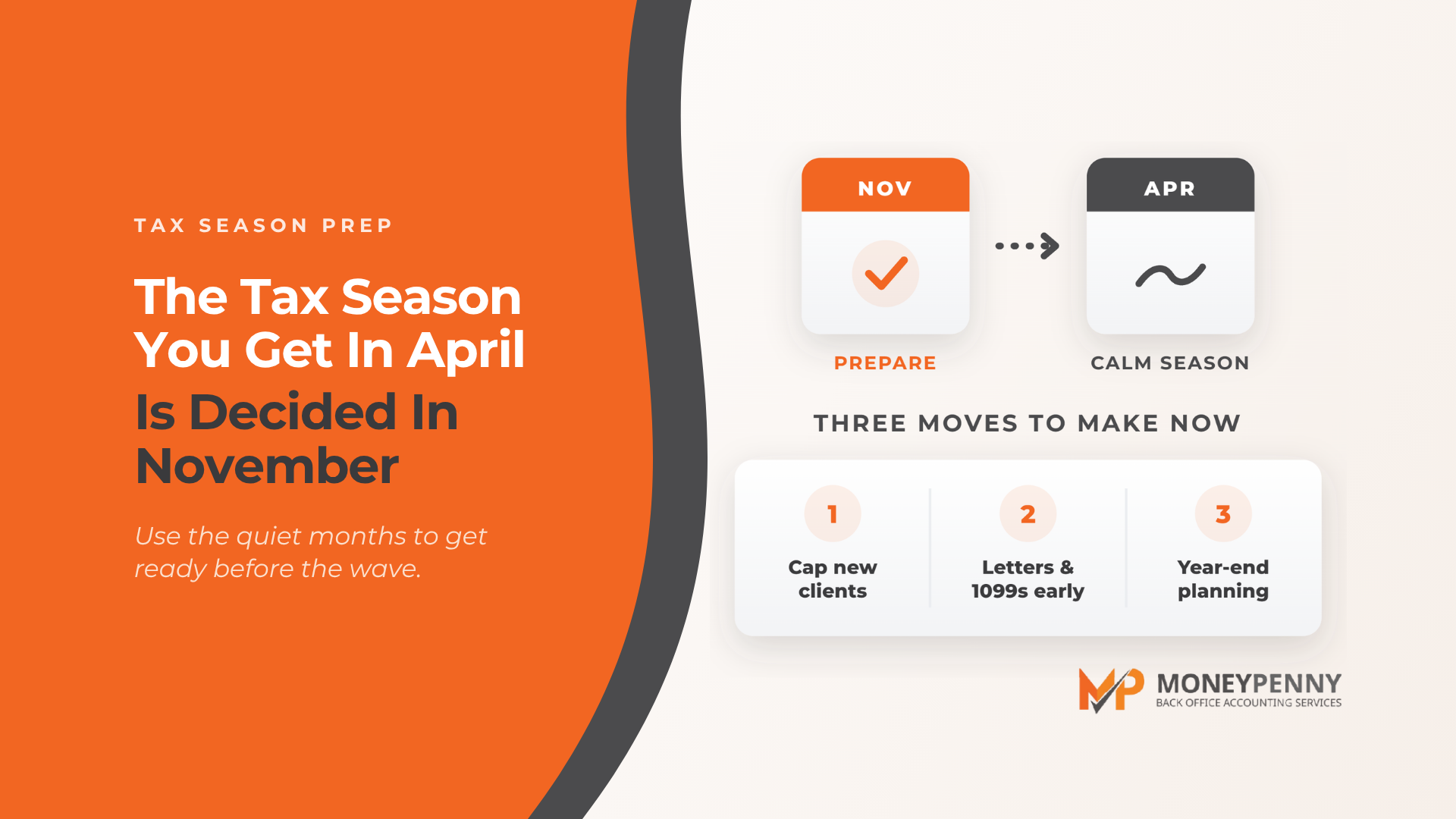
You cannot fix everything before January. But three moves take the most pressure off, and all three can be done now: draw a line on new clients so you can actually prepare, get your engagement letters and 1099 chasing started early instead of in the January scramble, and write to every client about year-end planning while there is still time to act on it. The rest of this piece is how to do each one.
Why draw a line in the sand on new clients?
Here is a decision more firms should make on purpose: set a date after which you stop taking on new tax clients for the season.
It sounds like turning away money. It is actually protecting something more valuable. If you keep saying yes right up to the deadline, you cannot build the teams, the processes, and the onboarding needed to deliver well. You just pile more work onto people who are already stretched, and the quality your good clients rely on starts to slip. As the thinking goes, the difference in income is not worth the difference in stress, and a client who comes to you at the last minute is usually a mess anyway.
Drawing the line early does something clarifying. It forces every other decision. Once you have said “no new clients after this date,” you know exactly how big the teams need to be, what has to be onboarded, and what has to be ready by the second of January. The cutoff is not the restriction. It is what makes the preparation possible.
Where does the easiest growth actually come from?
While you are saying no to new clients, there is a quieter yes worth paying attention to: your existing clients.
More work from current clients is far cheaper and far smoother than winning someone new. They are already set up with you, already know how you work, already have the secure channels in place. Adding a new service for an existing client is a slam dunk next to onboarding a stranger. And your clients are not going to stop growing during the season, so they will keep sending work your way regardless.
There is a specific version of this that pays for itself. Write to every one of your clients, not just the ones you assume need it, and offer to talk about year-end tax planning. Firms that have done exactly that report the conversations turned into real revenue, not just tax planning, but business advice, cash-flow work, and more. And it does something else valuable: it gets clients organising their affairs in October instead of February, which pulls the whole season forward and takes pressure off the worst weeks.
What should already be moving before January?
Here is the honest test of whether a firm is ahead: how much of the administrative work is already done before the year even turns?
The firms that call in the first week of January to “start” their 1099s are already behind. The work of chasing W-9s, sending engagement letters, getting organisers out, collecting documents, all of that can begin now. Get the letters out this month. Give an admin the checklist and let them run it. If you collect eighty percent of what you need in October and November, you are only chasing the last twenty in January, instead of starting from nothing in the busiest weeks.
The same goes for the tools. Digitising engagement letters and signatures does not require an expensive system. The point is to set it up so it tracks itself: a couple of clicks to send reminders, a report on what is still outstanding. Chasing paper in mid-January, while payroll and 1099s are already screaming for attention, is exactly the friction you can remove now.
And if you are going to put in a workflow or a new process, do it now, not on the fifteenth of December. A tool dropped in days before the rush has no time to be tested. Build it while there is room to get it wrong and fix it.
Do you actually have the capacity for what is coming?
Most firms do not have enough capacity for the season ahead. The time to find out is now, not in February.
Capacity does not only mean hiring. It means thinking flexibly about who does the work and where. There are experienced people who will happily do eight hours a day of returns through the season but will not come into an office, may not be in your state, may not be in your time zone, and that is fine, if you are set up for it. It also means your current team: someone working from home with a sick child, or avoiding a brutal commute on the worst weather days, needs to be able to work securely from anywhere. Winter is flu season and storm season, and the firm that assumes everyone will always be in the office is the firm that grinds to a halt the first week someone cannot be.
Getting set up for that is a pre-season task. The secure remote access, the VPN, the multi-factor authentication, the encrypted communication, none of that should be improvised in the middle of the rush. It is your name on the return and on the sign outside. The security that protects it belongs in place before the season, not scrambled together during it.
Why do good firms get out of the way?
There is a trap that quietly wastes the pre-season, and it is not a lack of effort. It is the opposite: an owner who cannot hand anything off.
The pattern is familiar. Someone insists on building the perfect process before anyone else can touch the work, and in the meantime nothing moves. The team is sitting there, capable and willing, waiting to be allowed to contribute, while the owner is convinced it all has to run through them. The fix is uncomfortable but simple: get out of the way. You do not need the perfect brief before you hand something over. Kick it off, give it structure and direction, and let a capable team run with it, then bring back what needs adjusting.
Everyone wants a purpose and a win. A team that is trusted to shape the work is a team that is invested in a smoother season, and they will often improve on what you would have built alone. Being a manager is giving people a structure and the room to make it work, not doing everything yourself and calling it standards.
The reason any of this matters
It is worth remembering why this is not just an efficiency exercise. Bad tax seasons make good people quit, not just jobs, but the profession. The misery of a season with no plan, no breathing room, and no end in sight is why firms lose people they cannot afford to lose.
It does not have to be that way. Book the March break now, and let that force the preparation that makes it possible. Sit the team down and run the simple exercise: what do we stop doing, what do we need to work on, and what do we start. Pick the two or three things that will matter most, and begin them while there is still time. The season is coming either way. Whether it is brutal or manageable is being decided right now.
If it would help to have someone help you work out the two or three things worth doing before the season hits, and to build the capacity to handle it, that is a conversation we have with firms every year, and the kind of thing a good back-office team is built for. Because sometimes saying no is a capacity decision, and the right preparation is what lets you say yes to the work that matters.
For more on building a better accounting practice, MoneyPenny hosts Beyond Numbers, a podcast of practical conversations on capacity, workflow, pricing, technology and the realities of running a firm. Watch on YouTube, or listen on Apple or Spotify.