When a firm gets busy, the daily meeting is usually the first thing to go. The logic feels obvious: we are slammed, we do not have time to stand around talking, everyone needs to be heads-down getting work out the door. So the meetings get cancelled and everyone disappears into their own queue.
We do the opposite. In our own operation, we add a daily standup precisely when the pressure is highest, because that is exactly when a team most needs it. It sounds counterintuitive. It is one of the most useful things we do.
Here is why it works, and how it is structured, drawn from running it every day across a large team.
What is a stuck issue, and why surface it first thing?
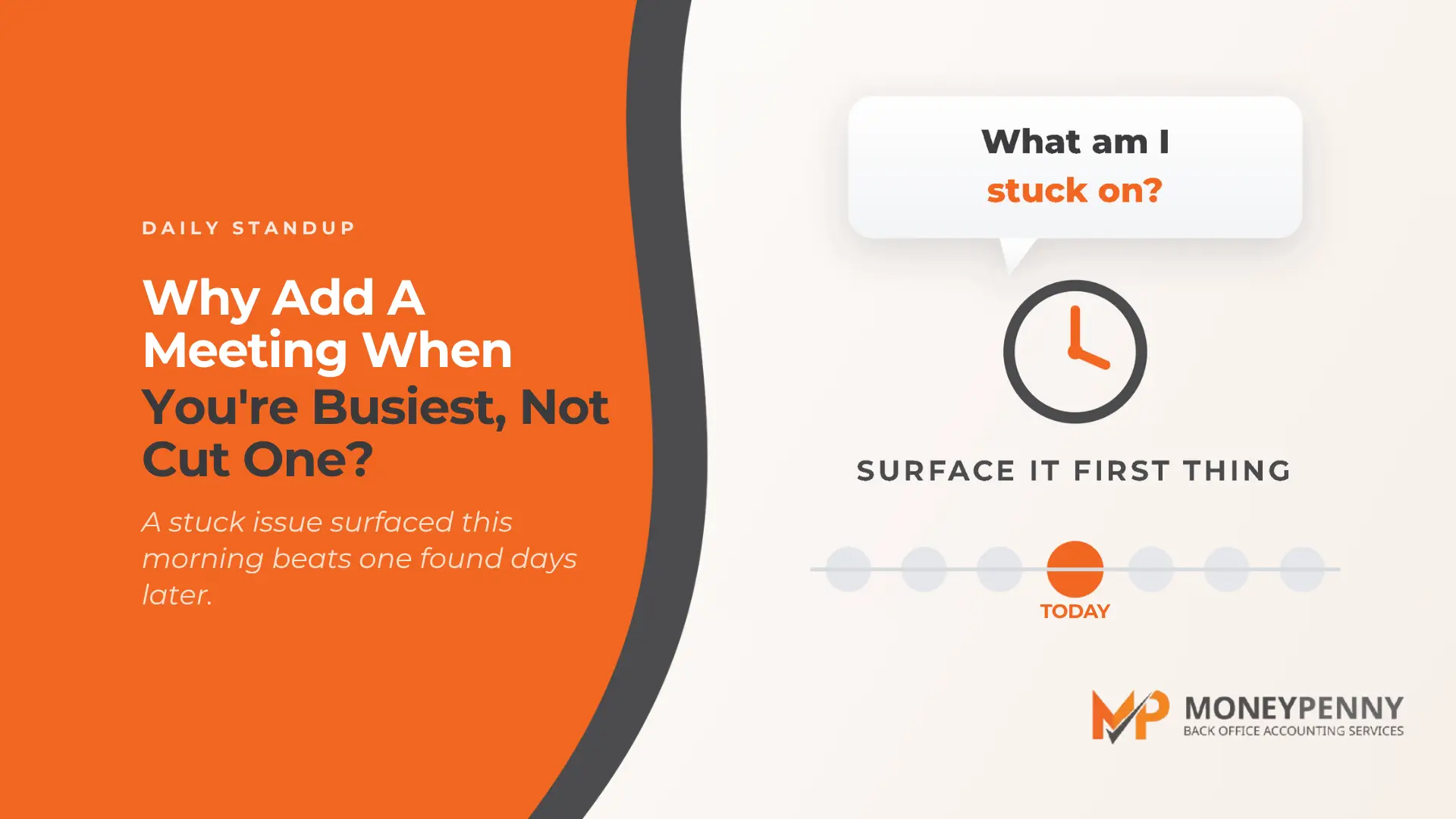
The heart of the standup is a single question each team brings to the table every morning: what am I stuck on?
That question matters because of timing. In most firms, a stuck issue sits quietly until review, or until the partner finally gets to look at the file, sometimes days later, after the work has already gone sideways. By then it has cost real hours. Surfacing it first thing in the morning changes that completely. When a blocker is named early, someone in the room often has the piece of information that unblocks it right there, before it becomes a problem.
It is the same in any firm, anywhere. The stuck issues exist whether or not you talk about them. A daily standup just moves them from discovered late, at review, to resolved early, in the morning.
How does one meeting replace walking the floor?
Before we ran a structured standup, the way information moved was one person walking from desk to desk, asking each team lead what was going on. Everything came through that one person. Which meant if they were out, or forgot to write something down, the information simply did not travel.
Plenty of firms still run this way. Very manual, very one-to-one, the manager physically walking to each person to get status and hear individual issues, even when there is a workflow tool sitting right there. It works until the firm grows past a certain size, and then it quietly breaks.
A standup that brings the whole leadership team together fixes it, and it does something the desk-to-desk method never could. When everyone is in the room, a team lead mentions a problem, and another lead realises they are facing the exact same thing and had no idea. More knowledge passes in that twenty minutes than in a normal week, because the people solving the same problems are finally in the same conversation instead of each working it alone.
How does a standup solve the busy-season capacity problem?
Here is the part that earns its place in the busiest weeks. The standup surfaces, every single morning, who is out and who has room.
Someone is sick. Someone has a planned day off. It happens in every firm, and busy season is also flu season, so it happens more. Without a shared view, that absence becomes a dropped ball. With a daily standup, the gap is visible immediately: this person is out today, here is who is covering, and if a team is light on work while another is drowning, a person moves across to where the deadline is.
That is capacity management happening live, once a day, instead of a crisis discovered after the fact. Teams stop being isolated silos and start behaving like one team that can shift weight to wherever the pressure is.
What does the structure actually look like?
The format is deliberately simple, and simplicity is what makes it stick. It runs on a simple, agreed template that everyone fills in the same way.
At the beginning of the day, each team lead notes what is due for each client, and what is priority. The meeting itself runs twenty to thirty minutes, no longer, and it is not a minute-by-minute recital of every task. It is the priorities, the stuck issues, and the coverage. Then at the end of the day, a second short pass: what got done, what did not, and the reason it did not, plus who was out and who covered for them.
Beginning of day, a short meeting, end of day. A few minutes at each point. That is the whole rhythm, and it replaces a constant stream of interruptions with two predictable moments where everything gets aligned.
One detail worth stealing: give the team the ability to change the template. A standup people helped shape is a standup people actually use. When the team knows they have a voice in how it runs, it stops being something imposed on them and becomes something that belongs to them.
Why does the standup report come before email?
A quiet side effect of running this well is that it reorders how information reaches you. Chat messages and emails pile up fast, sixty, seventy, eighty in a day, and things get buried. A note sent that way might never get actioned.
The daily standup report changes the order. It becomes the first thing to check each morning: is there anything here I need to handle? If more detail is needed, there is a link through to the fuller notes. Email drops to third place. Instead of hunting for what matters across a dozen channels, the thing that matters most is in one predictable place, once a day.
The meeting that firms sacrifice first, and should not
There is a companion habit that belongs with the standup, and it is the one firms abandon soonest under pressure: training.
When the crunch hits, the regular training session is usually first to be cancelled. We hold onto it, because letting it go is a false economy. When a client raises a concern about how something was handled, the fix is not just correcting that one file. It is walking through why it happened, how to prevent it next time, and what the right way to do it actually is, so the whole team learns it at once. Catch an issue early and teach it once, and you have stopped it repeating across thirty or forty other clients. Skip that, and you are back to fixing the same mistake over and over.
Training built into the culture, rather than squeezed in when there is time, is what lets a team keep up while everything around them changes. It is everyone’s responsibility, not a meeting that happens if the calendar allows.
Now is the time to build it
If any of this sounds like something your firm needs, the honest first step is small: pick a simple template, get the leads in a room for twenty minutes each morning, and ask the two questions that matter, what is priority, and what are we stuck on. Let the team shape it. Protect it when you get busy, because that is when it earns its keep.
The best time to build the habit is before the next busy season, not during it. Get it running and tested now, and it will be second nature when you need it most.
If it would help to have someone who runs this every day help you design one that works for your team, that is a conversation we have with firms all the time, and the kind of thing a good back-office team can walk you through.
For more on building a better accounting practice, MoneyPenny hosts Beyond Numbers, a podcast of practical conversations on capacity, workflow, pricing, technology and the realities of running a firm. Watch on YouTube, or listen on Apple or Spotify.