Ask most accounting firm owners what their onboarding process looks like and they’ll give you a rough answer.
Ask them to write it down, step by step, and the room goes quiet.
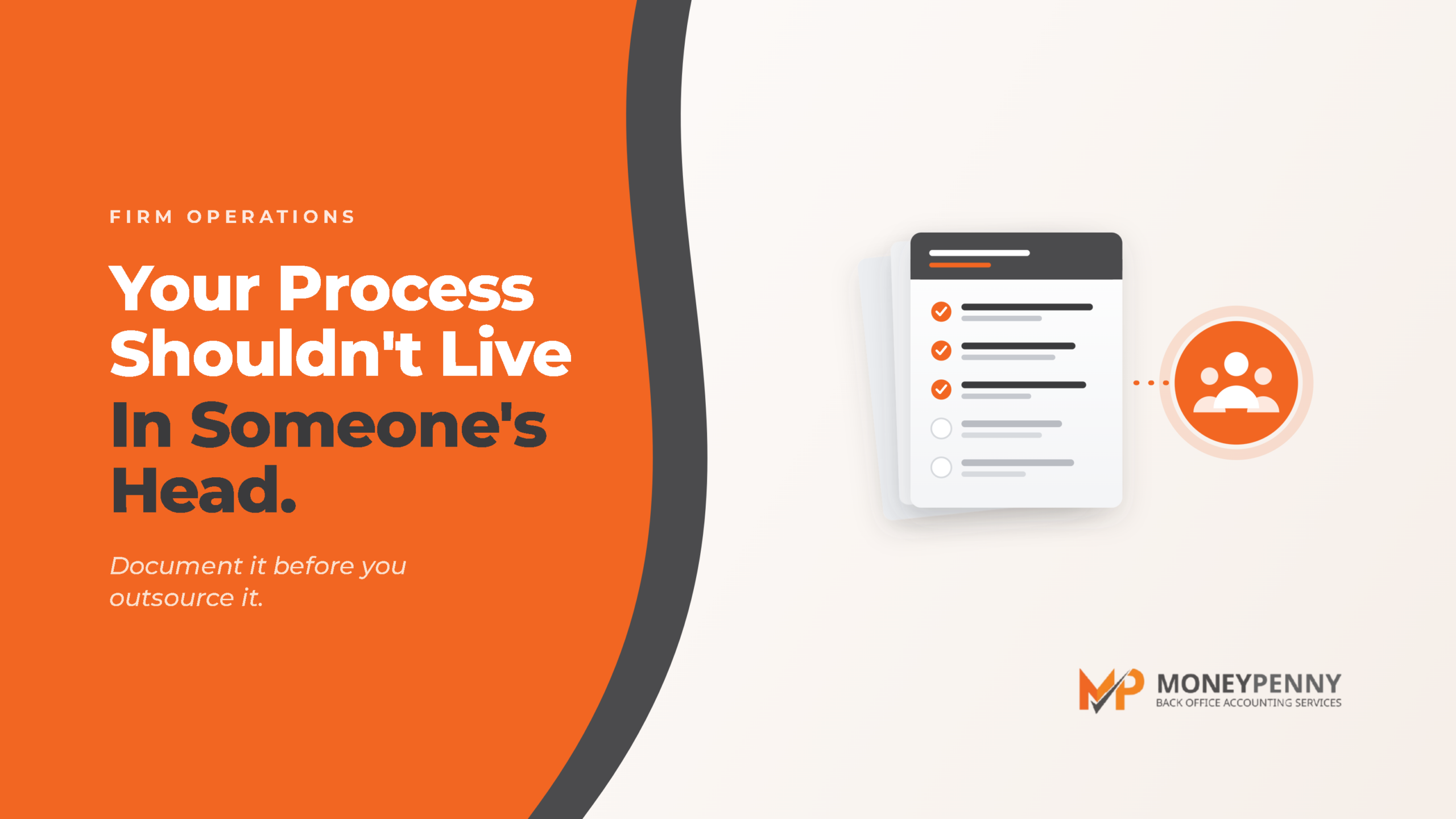
That gap between knowing how things work and being able to document how things work is where most outsourcing relationships run into trouble. And it’s a problem that’s entirely fixable -before you bring anyone new in.
Why documentation gets skipped
It’s not laziness. It’s urgency.
Most firms are moving fast. Client work is coming in. Deadlines are live. There’s always something more pressing than sitting down to write out a process that everyone already knows, or thinks they know.
The problem is that “everyone knows” is almost never true. Everyone knows their version of it. And in a firm with three, five, or ten people, there can be three, five, or ten slightly different versions of the same process running simultaneously.
That works, until it doesn’t. And it stops working the moment you try to bring someone new in.
What undocumented processes actually cost you
The costs are real, they just don’t show up on a balance sheet:
Onboarding time doubles.
A new hire or outsourcing partner can’t follow a process that exists only in someone’s head. Someone has to teach them. That takes time away from the work that’s already piling up.
Quality becomes inconsistent.
When everyone does things slightly differently, the output varies. Clients notice. Errors creep in. Reviews take longer.
You become dependent on individuals.
If one person holds all the knowledge and they leave, get sick, or simply have a bad week, the whole workflow suffers. That’s a fragile way to run a firm.
Outsourcing fails before it starts.
According to research published by the Project Management Institute, organisations with standardised processes are significantly more likely to deliver projects on time and within scope. The same principle applies directly to accounting firm workflows.
What standardisation actually means in practice
Standardisation doesn’t mean every client gets an identical experience. It means the internal process for handling client work is consistent, regardless of which team member is doing it.
It means:
- The same steps happen in the same order every time
- The same information is collected from clients at the same point in the workflow
- The same tools are used in the same way across the team
- The same person is responsible for each step, and that responsibility is written down
It’s not complicated. But it requires sitting down and doing the work of mapping it out before you need it, not after something goes wrong.
The standardisation gap in practice
At a recent industry workshop, firm owners were asked to document what happens from the moment a client engages with their firm to the moment work is delivered.
After fifteen minutes, most pages were still blank.
These were experienced professionals who had been running their firms for years. They knew their work deeply. But the process lived in their heads, not on paper. And that meant it couldn’t be taught, scaled, or handed off reliably.
That’s the standardisation gap. And it’s more common than most firms want to admit.
A practical starting point
You don’t need a full operations manual on day one. Start with the most common workflow in your firm – the one that happens most often and involves the most people.
Map it out:
- What triggers this workflow? What does the client send, and how?
- Who receives it and what do they do first?
- What happens at each step and who is responsible?
- What does the client need to provide at each stage?
- What happens if something is missing or delayed?
- What does the completed output look like and who reviews it?
Write that down. Review it with your team. Fix what’s unclear. Then move to the next workflow.
It won’t take as long as you think. And the return on that time investment compounds every time you onboard a new team member, bring in an outsourcing partner, or try to take on more clients without burning out your existing staff.
Another tip to help you document your processes – record it. Loom is a fantastic tool for recording your processes which includes your voice over. Zoom as well can do a pretty good job of recording, creating a transcript. And from there, building your processes.
At MoneyPenny we use Whale.io to help us build our SOPs. Whale allows us to record the process and voice-over, then creates the step-by-step process – ready for review. Whale has enabled us to build processes on the fly, simply be recording the various steps in the process.
Then bring in outside support
The firms that have the best outsourcing experiences are almost always the ones with the clearest internal documentation.
Not because the outsourcing provider needs everything handed to them on a plate – though that helps – but because the process of documenting forces the firm to identify and fix the gaps before they become someone else’s problem.
When the process is clear, onboarding is faster. Expectations are set properly. Work flows the way it’s supposed to. And both sides of the relationship can focus on doing the work instead of figuring out how the work is supposed to get done.
Documentation isn’t a nice-to-have. It’s the foundation that everything else is built on. At MoneyPenny LLC, the firms we work with best are the ones who’ve already done this work and for those who haven’t, we’re often the reason they finally do.
Need help with documenting your processes and procedures? Contact us we can help either create them or test and update your current SOPs.