Most firms do not fail to change because they picked the wrong tool or the wrong process. They fail because, somewhere around week three, the effort goes quiet. The new system gets used halfway. The project loses its owner to other work. And slowly, without anyone deciding it, the firm drifts back to the way it always did things.
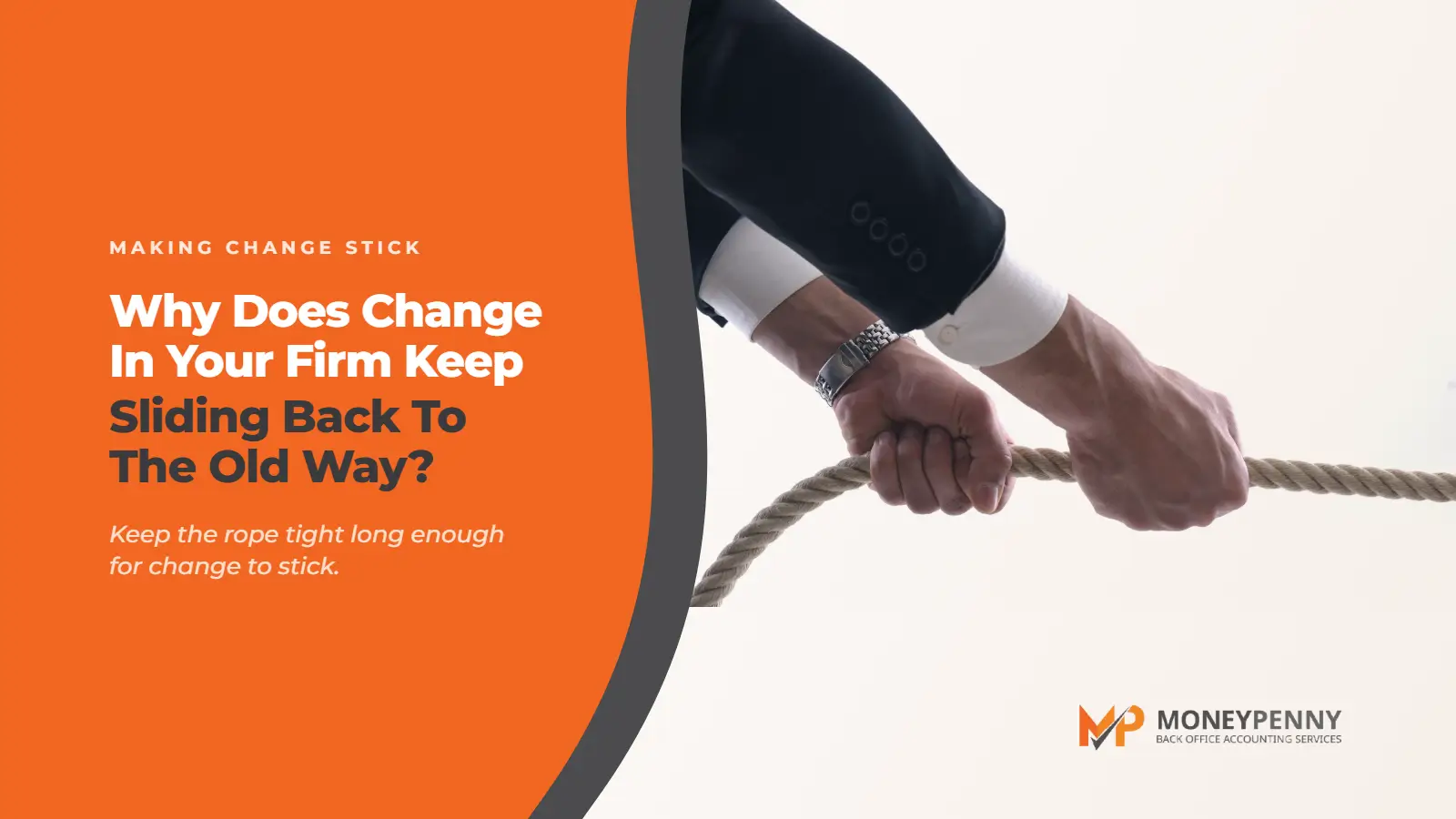
There is a useful image for why this happens. Think of change as a tug of war. The only way a rope moves anything is if it stays tight. The moment you let slack into it, nothing moves, and the other side, the pull of the old way, drags you straight back into the mud. Slack is the enemy of change, and slack is exactly what a busy firm produces by accident.
This is the right time of year to take that seriously. The stretch after summer and before tax season is the best window a firm gets to change how it works. So before the season closes it, the question worth asking is not what should we change, but how do we keep the rope tight long enough for the change to actually stick.
Why is the old way so hard to leave, even when it hurts?
The honest answer is that the status quo, however painful, is familiar. Working until nine at night through tax season is miserable, but it is a known misery. You have survived it before. Change asks you to trade a discomfort you know for a process that is uncertain, with difficult conversations along the way, and the brain quietly prefers the devil it knows.
That preference is what pulls the rope slack. Every time the change gets hard, returning to the old way offers relief, and relief feels like the sensible choice in the moment. It is not. It just locks in another year of the same, which is why so many firms can describe exactly what they would like to be different and still arrive at next tax season unchanged. Seeing the end result is easy. Getting there can feel like pulling teeth, and most firms put the pliers down too soon. Worth remembering what a real change can bring your firm when the pulling gets hard, because the payoff is the whole reason to hold the tension.
Who is actually holding the rope?
Change needs an owner. Not a committee, not everyone-and-therefore-no-one, but a named person who is given both the authority to drive it and the space to do it.
That second part is where most firms quietly undo themselves. They appoint someone, hand them the project, and then, over the following weeks, keep pulling them back. Before you get started, can you just handle this. While you are in the middle of that, can you also cover this. Each small interruption looks reasonable on its own. Together they are how slack creeps into the rope. The champion never gets a clean run, the momentum fades, and the project stalls with a built-in excuse for why it never finished.
If you are going to ask someone to own a change, protect their time the way you would protect a client deadline. The role is real work, even though it does not show up as billable hours, and treating it as something to be squeezed in around the edges is the same as deciding it will not happen.
Should one person really carry the whole thing?
Here is a shift that makes change far more durable: stop looking for a single hero to run it end to end, and start thinking of it as a relay.
Different people are built for different parts of a change. Some are natural fact-finders, the ones who turn up with the article, the idea, the “have you seen this.” Some are implementers who love getting into the detail and building the thing. And some are finishers, the ones who close out the last mile that everyone else loses interest in. Almost nobody is strong at all three, and you do not want them to be. You want the fact-finder to do their part and then hand the baton to the implementer, who builds and hands off to the finisher, while the tension on the rope never drops during the exchange.
This matters practically, not just in theory. The person who dreams up the change is rarely the person who should document every template, and the person who documents it is rarely the one who enjoys chasing the final ten percent to done. Matching people to the part of the race that suits them means each stretch gets someone who actually wants to run it, and the whole thing moves faster than one exhausted quarterback trying to carry it alone. It is also, as a side benefit, a good way to put the right people in front of the right work long after this one project is finished.
What is the leader’s job once the change is handed over?
A common trap: the owner sets a vision, tells the team they are empowered, steps back entirely, and then wonders months later why nothing moved. Stepping back is not the same as disappearing.
The leader’s job through a change is to keep reinforcing the why, keep the tension on, and cheer the team on from the sidelines, especially through the difficult middle where the old way is calling everyone home. It is close to watching someone learn to walk: you are not doing it for them, but you are right there, and you do not wander off the moment they wobble. The firms that get this wrong fall into one of two ditches. Either the owner will not let go at all, cannot give up control, and so sabotages the very change they asked for. Or the owner lets go completely, offers no reinforcement, and lets the rope go slack from the top.
The version that works sits in between. Hand the roles to the people who raised their hands, let them actually do them, and stay close enough to keep pulling everyone through the tight spots.
What if it does not work?
The last thing that keeps firms frozen is the fear of getting it wrong. It is worth putting that fear in proportion. This is not heart surgery and it is not a moon landing. The worst case of trying a change and not reaching perfection is that you learn what does not work, and often that points you at something you did need and had not seen.
So the real risk is not a change that half-works. It is a year of being miserable while trying nothing. Pick one or two things, not the whole firm at once. Give them to the right people. Keep the rope tight. And accept that a bit of tension now is the price of not spending another season exactly where you are. If having someone alongside you who has pulled firms through this kind of change before would help, that is a conversation our outsourced back office accounting support team has often, and it is the groundwork behind CAS and advisory support for firms ready to change how they work, not just what they deliver.
For more on building a better accounting practice, MoneyPenny hosts Beyond Numbers, a podcast of practical conversations on capacity, workflow, pricing, technology and the realities of running a firm. Watch on YouTube, or listen on Apple or Spotify.