Most firms hand a client the same three things every month: the profit and loss, the balance sheet, the statement of cash flows. Printed, emailed, lobbed over the fence, job done. And most clients glance at them, understand almost none of it, and file them away unread.
The reports are not wrong. They are just not the answer the client was actually looking for. And the gap between “the reports we produce” and “the answer the client wants” is one of the most valuable spaces an accounting firm can move into, if you think about your reporting, and the tech stack behind it, differently.
Why is a good report more like a map than a document?
Here is a way to think about it that changes everything. A map and a financial report have more in common than they look.
Take any piece of land. All the data about it is fixed: the roads, the water, the elevation, the boundaries. But you never show all of it at once. You make a thematic map, one that pulls from all that data but focuses on a single thing. A water map. A roads map. A population map. Same underlying data, different theme, because different people need to see different things.
Financial reporting works exactly the same way. The data is all in one place. But the head of sales needs to see commissions one way, so he can tell his salespeople what they have earned. The CFO needs to see those same commissions a completely different way, so she can track why the money on signed contracts is not coming in. Same data. Two different maps.
Once you see reporting like this, the job stops being “run the standard reports” and becomes “build the right map for each person who needs one.” That is a far more valuable thing to offer, and it is what clients actually want.
What should you ask before you build a single report?
The instinct is to reach for the software’s built-in reports. The better move is to start with a question, not a tool: what does this person actually need to know?
What does the owner need to see every morning to know the business is on track? What does the sales lead need each week? What keeps this particular client awake at night? The answers are almost never “a standard profit and loss.” They are specific, personal, and often not in any default report at all.
This is the real work of a virtual controller or a client accounting service, and it is genuinely valuable. You have all the data in one place. Sitting down with a client to work out the handful of views that matter to them, and then building exactly those, is worth far more than printing the same pack everyone else prints. Teach a business owner which numbers tell them their business is healthy, and you become the person they cannot run the business without.
How does the tech stack actually fit in?
Here is where the tech stack finds its proper place, and it is the reverse of how most firms think about it. The stack does not come first. The reporting need comes first, and the stack is assembled to serve it.
The general ledger is your foundation for financial reporting. The apps around it exist to produce the managerial reporting the GL alone cannot, the different maps, pulled from the same data, cut for different people. You do not pick tools and then figure out what they can show you. You work out the views people need, and then choose the tools that deliver them, feeding everything back into the one source of truth.
That reframe matters because it stops the endless chase for the perfect app. The question is never “what is the best tool?” It is “what does this client need to see, and what is the simplest stack that shows it?”
Why is a tech stack never actually finished?
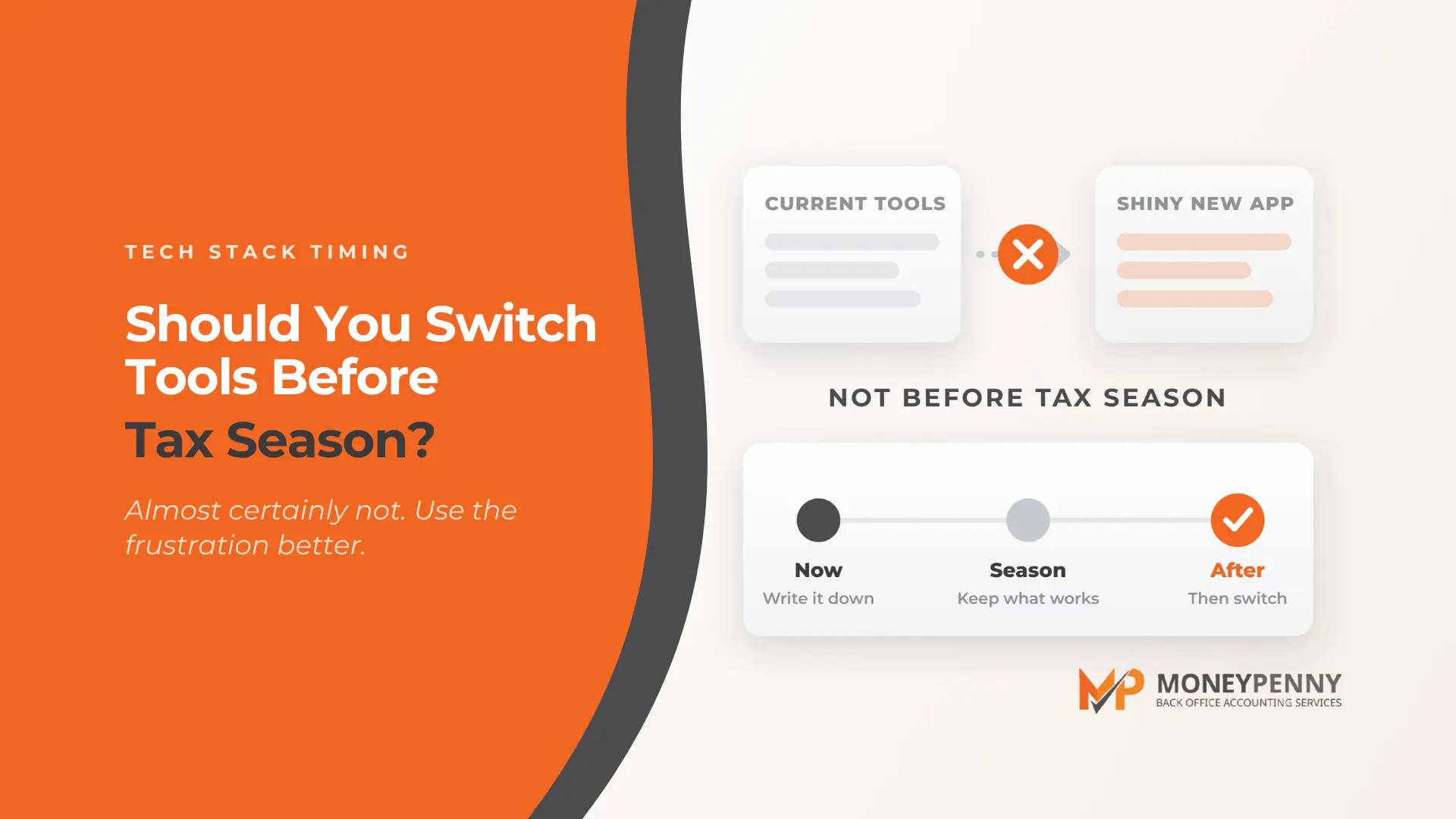
Here is the trap that catches even firms who get the setup right: they treat the tech stack as “set and forget.” It never is.
Two things change constantly, and each one can quietly make your stack wrong. The apps change, they add features, drop them, improve, decline, and shift relative to each other. And the firm or the client changes, a business that was doing a few million a year lands a big contract, doubles in size, and suddenly needs reporting and functionality the old stack was never built for. Either shift can leave you running tools that no longer fit.
So a tech stack needs reviewing, not just when something breaks, but on a rhythm. Somewhere between six and twelve months is a sensible outer limit before you check, deliberately, whether this is still the right stack for where the client or the firm is now. The question is not “does it still work?” It is “is it still the right fit for where we are today?” Those are very different questions, and only the second one keeps a firm ahead.
Who in your firm actually owns the technology?
All of this points to a role most firms do not fund, and should. Someone whose job is to own the tech.
Think about everything that role covers: managing the integrations between apps, onboarding and training clients onto them, reviewing whether the stack still fits, and, crucially, building real relationships with the app vendors so that when something goes wrong, help comes fast. That is not a side task someone squeezes in between returns. It is close to a full-time job in a growing firm, and there is no way the owner, who is already carrying clients, team, and everything else, can do all of it well.
The objection is always the same: but that person is not billable. The answer is that if the technology is not working, nobody is billable. The team cannot deliver, the reports do not come out, the clients do not get their answers. Real capacity in a firm is not only billable hours. It is also whoever keeps the technology, the client experience, and the vendor relationships running so that the billable work can actually happen. That seat pays for itself in the work it unblocks.
The bigger picture
Underneath all of this is the same thread that runs through so much of running a good firm: create the space for someone to think. Space to sit with a client’s problem, look at the tools available, talk to the vendors, and work out the right answer. The firms that make room for that, rather than cramming every hour with billable production, are the ones whose clients quietly double, because someone had the room to make the technology genuinely serve the business.
Your clients do not want your reports. They want their answer. Build the stack, and the reporting, around giving it to them.
If it would help to have someone help you build the right stack for where you are now, and the reporting your clients actually want, that is a conversation we have with firms all the time, and the kind of thing a good back-office team is built to support. It often starts with the tech stack review that begins from what you already own.
For more on building a better accounting practice, MoneyPenny hosts Beyond Numbers, a podcast of practical conversations on capacity, workflow, pricing, technology and the realities of running a firm. Watch on YouTube, or listen on Apple or Spotify.